Every founder eventually hits the point where their spreadsheet-based financial planning is no longer good enough. The numbers are too complex, the decisions too consequential, or the time cost too high. At that point, three realistic options are on the table: hire a full-time CFO, bring in a fractional CFO, or use an AI CFO platform. All three are legitimate. The mistake is choosing based on status rather than fit. In 2026, with AI CFO tools maturing and fractional CFO rates rising, the economics of this decision look different than they did three years ago.
What Each Option Actually Costs in 2026
Total cost of employment and engagement varies significantly by market, experience level, and scope. The table below uses realistic 2026 ranges for US and Australian businesses in the $500K to $10M revenue band, where this decision is most relevant.
| Option | US Annual Cost | AU Annual Cost | Availability | Typical Scope |
|---|---|---|---|---|
| Full-time CFO (mid-market) | $180K–$280K total comp | $200K–$320K total comp (inc. super) | Daily, full-time | Strategy, treasury, compliance, team management, board reporting |
| Fractional CFO (mid-tier) | $2,500–$8,000/month | $3,000–$10,000/month | Weekly or bi-weekly | Financial planning, investor reporting, strategic advisory |
| Fractional CFO (senior/PE-backed) | $8,000–$18,000/month | $10,000–$20,000/month | Weekly, higher hours | Complex capital structures, M&A, board-level financial leadership |
| AI CFO Platform | $49–$299/month | $49–$299/month (USD-priced) | Always-on | Cash flow forecasting, scenario modeling, monitoring, reporting |
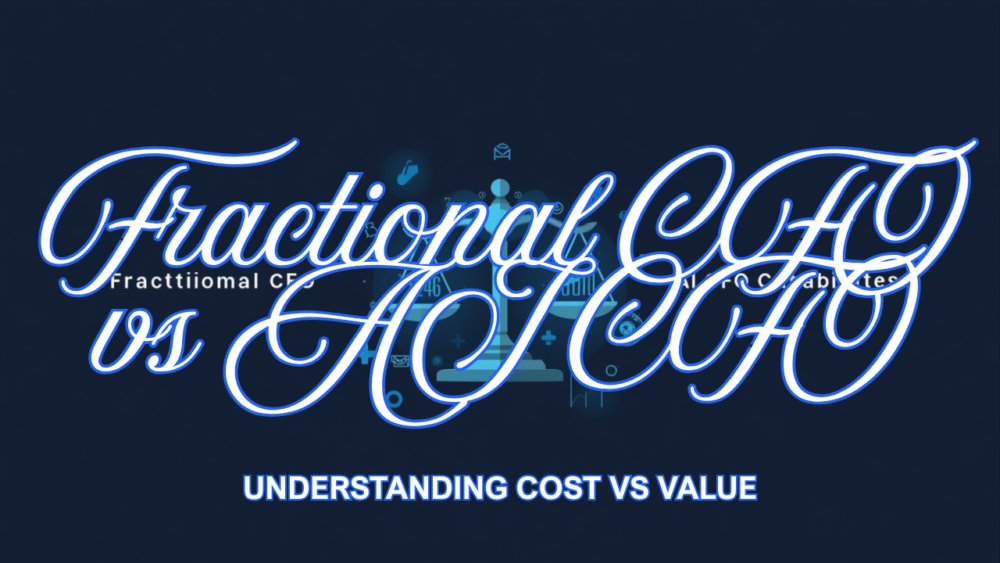
The cost gap between an AI CFO platform and a fractional CFO is roughly 20x to 60x, depending on the fractional CFO’s rate. That gap does not mean the AI platform is always the right choice. It means the question of what you are actually buying with each option matters more than the headline number.
What a Fractional CFO Brings That Cannot Be Automated
A fractional CFO is a senior finance operator who brings judgment, network, and lived experience to your business. The things that justify their rate are not the things that can be automated: negotiating with a bank during a covenant review, advising on a term sheet, managing a board presentation, or making a call on whether to delay a product launch based on the financial picture they see. These require human pattern recognition built over years of operating experience.
Where fractional CFOs create the most value is in moments of significant financial decision-making: a fundraise, an acquisition, a major hire, or a restructuring. For businesses operating below $2M that are not fundraising, the day-to-day advisory that a fractional CFO provides is often overkill relative to the cost.
The best use of a fractional CFO in 2026 is also increasingly hybrid: a fractional CFO who uses an AI platform for the monitoring and forecasting work, and reserves their time for the advisory and strategic layer. This model typically comes in at the lower end of fractional CFO rates because they are not billing for time spent rebuilding your cash flow spreadsheet every month. The platform handles that.
What an AI CFO Platform Does That Fractional CFOs Don’t Scale Well
An AI CFO platform provides three things that fractional CFOs structurally cannot deliver at the same cost: constant availability, data-connected forecasting, and scenario speed. Your fractional CFO is not checking your cash position on a Sunday night. An AI platform is.
For businesses running QuickBooks or Xero, an AI CFO like Noya connects directly to that data and builds a live cash flow view that updates as transactions come in. The forecast is not a model the CFO built three weeks ago and emailed over. It is the current state of your finances projected forward. That is a fundamentally different product.
The scenario modeling speed is also categorically different. Running a “what if we hire two people in Q3 and revenue grows 20%?” scenario through a fractional CFO means scheduling a call, waiting for a model to be built, and getting back a spreadsheet that is already outdated. Running the same scenario in an AI platform takes 60 seconds. For founders making multiple decisions per week, the compounding value of that speed is significant.
The honest limitation: an AI CFO platform does not replace the advisory relationship, the industry network, or the qualitative judgment a senior finance operator brings. If you are raising capital, going through an audit, or managing a complex restructuring, you need a human. The platform cannot replace that.
The Decision Framework: Which Option Fits Your Stage
The right choice is mostly determined by revenue, complexity, and the nature of your current financial challenges.
- Under $2M revenue, no fundraise planned: AI CFO platform is likely sufficient for your planning needs.
- $1M–$5M revenue, strategic decisions ahead (hire, expand, raise): Fractional CFO, ideally one using an AI platform. Budget $3,000–$6,000/month.
- $5M+ revenue or complexity (multi-entity, capital markets, M&A): Fractional CFO at senior rate or full-time hire depending on volume of decisions.
- Any stage, existing fractional CFO: Add an AI platform. It does not compete with what they do; it frees them to do more of it.
The fractional CFO model is increasingly built around AI tools, not in spite of them. The advisors who are winning mandates at higher rates in 2026 are the ones who deliver faster, more data-driven financial insight because they are not doing manual forecast work. The advisors who are not using AI are spending more hours on commodity work and billing for time that clients increasingly do not want to pay for.
See What AI CFO Looks Like for Your Business
The most efficient way to decide whether an AI CFO platform replaces something you are currently doing manually is to connect your accounting data and look at what it shows you. Finoya’s full feature set includes cash flow forecasting, scenario modeling, cash health monitoring, and Noya AI recommendations. Plans start at a fraction of what a single fractional CFO session costs.
Create your free Finoya account and see your cash position, forecast, and first AI-powered recommendations in under 60 seconds.