
The first time I Googled “how to know if my business is running out of cash” it was 4:42am on a Tuesday. I was sitting in my bedroom floor. I had just opened the bank account and the number was lower than I was expecting. Panic set in.
I was running my last startup at the time. Revenue was growing. Customers were happy. By every surface metric we were winning. But that morning I could not work out whether we had three weeks of runway or eight. I could not work out whether the weird dip in the last two weeks was a seasonal thing or the beginning of a trend. I could not work out which of our outstanding invoices were going to land and when. I was supposed to be running a company and I did not know any of this.
I called my accountant at 10am. He never picked up so I mailed and after a couple of hours he replied “let me pull the numbers and get back to you in a couple of days.” He did not have the urgency or panic I did.
That was the week I started thinking about Finoya.
What I wanted then, and what Finoya does now
I did not want a dashboard. I had a dashboard. I had QuickBooks. I could stare at charts all day and still not know what to do. What I wanted was something that would look at my actual numbers and tell me, in plain English, what was going on and what to do about it. The way a good CFO would if I could afford one.
A fractional CFO in Australia or the US starts at around $3,000 a month and goes up fast from there. If you are between $500K and $2M in revenue you probably cannot justify that, or at least I could not. But the question a fractional CFO would answer, I still needed answered. Every Tuesday morning.
So we built the thing. That is all Finoya is. An AI CFO that costs less than a coffee a day and answers the questions you would pay a real CFO to answer, based on the actual numbers in your Xero or QuickBooks account.
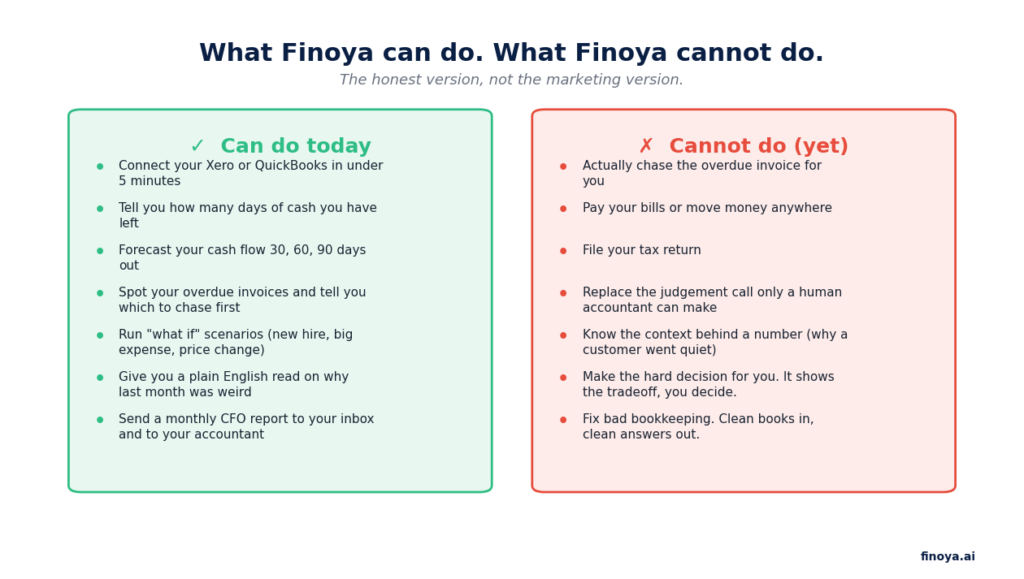
I want to be honest about what it does and what it does not. Most AI product blogs are allergic to that. I find it more useful than marketing copy.
The Tuesday morning test
The way I think about whether Finoya is useful to a founder is what I call the Tuesday morning test. It is the thing that was happening to me in the bedroom. You open your bank balance. Something does not look right. What happens next?
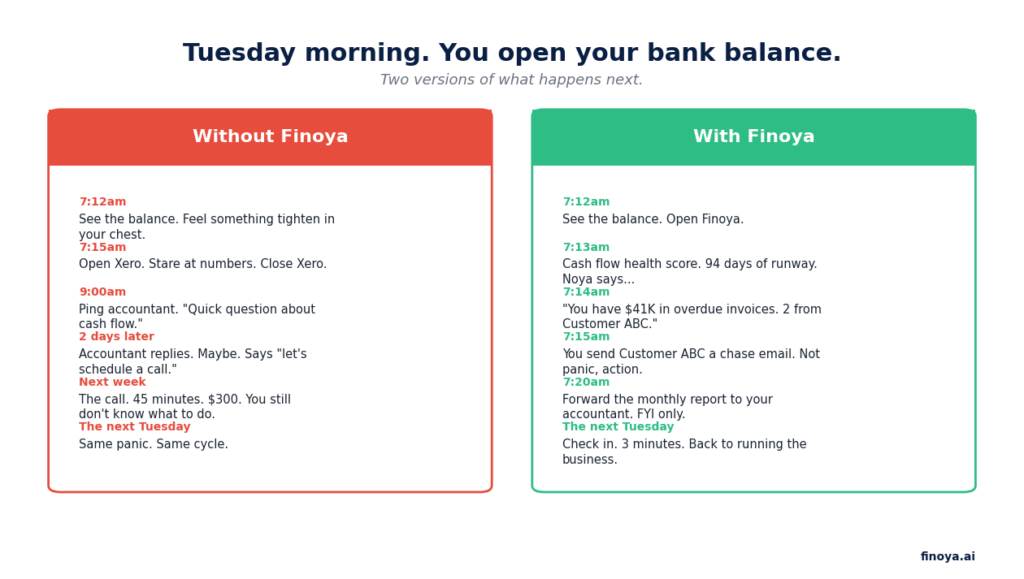
That is not a marketing line. That is literally what our design partners told us happens when they start using it. The panic cycle breaks. Not because the numbers got better. Because they could see them, and they knew what to do.
What Finoya actually costs and how the trial works
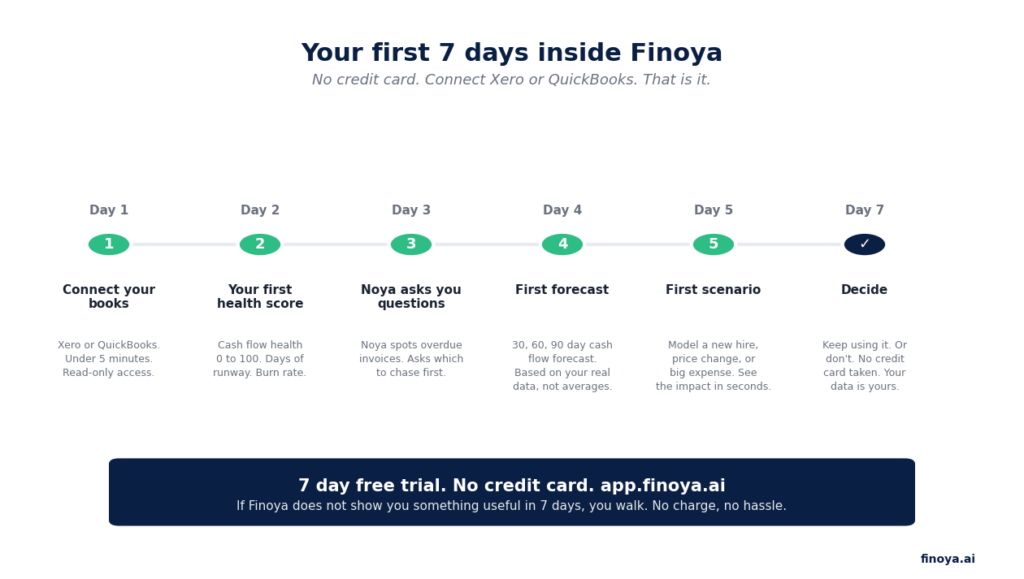
You connect Xero or QuickBooks or 20 other accounting platform. Takes under five minutes. Read-only access. We never move money, we never file anything, we never touch your books. We read them and we tell you what they mean.
You get seven days free. No credit card. If after seven days it is not useful, you walk. If it is, it is $49 a month for a single business. If you run multiple entities, there are other plans. Most founders I talk to tell me the forecasting alone pays for it the first week.
Why I am writing this
I am not going to pretend this is the only tool you need. It is not. Your accountant is still the person who understands your context, your structure, the decisions only they can make. Finoya does not replace that. What it replaces is the 4:42am bedroom panic.
If you are a founder running a business somewhere between $500K and $5M in revenue, and your Tuesday morning looks anything like mine used to, try it. Connect your Xero or QuickBooks. See what it says. Ask Noya the question that has been sitting on your chest for a week.
Seven days, no credit card. Start here. If it is not useful by day three, I would honestly rather you stop using it and tell me why than waste your time.
That is not a marketing promise. It is a founder writing to another founder. I built this because I needed it. If you need it too, good. If you do not, that is fine.