
I want to walk through some numbers I have been hearing from fractional CFO operators over the last six months. They are not numbers anyone is publishing in a marketing deck. They are the kind of numbers that come up in private conversations after the second drink at an industry dinner.
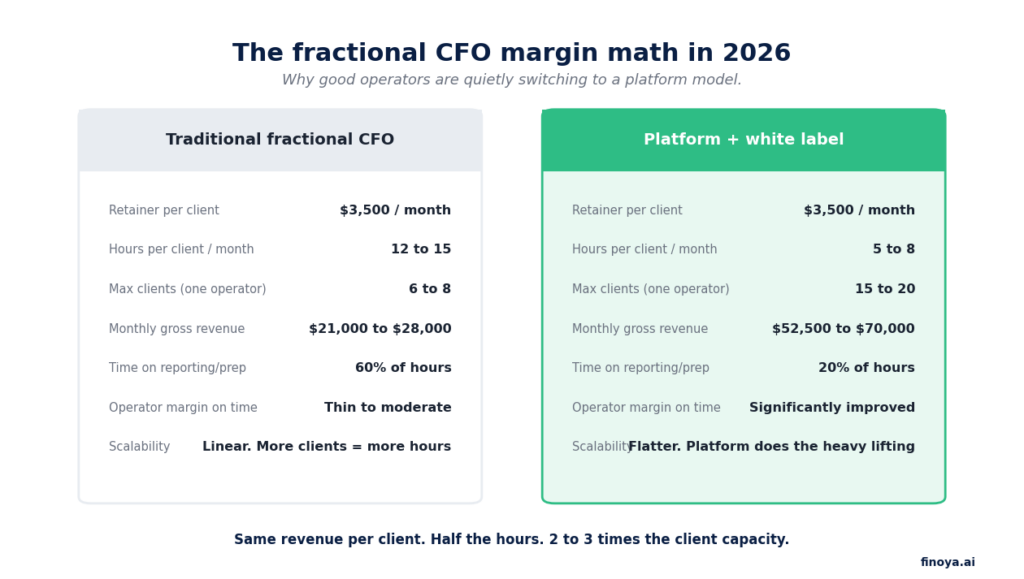
The fractional CFO market in the US has roughly tripled since 2020. The reason it grew is that mid-market businesses needed CFO-level work but could not afford a full-time CFO at $250,000 to $400,000 plus equity. Fractional CFO at $3,500 to $5,000 a month was the answer. Six to eight clients per operator. Annual gross of around $250,000 to $350,000 for the operator. A real business.
The problem the operators are now talking about quietly is that the model has stopped scaling. Every additional client is another 12 to 15 hours a month of operator time. The margin per hour is fine. The margin per operator is capped. And the operator is the bottleneck.
The honest hours breakdown
Almost every operator I have spoken to has the same hours problem. Of the 12 to 15 hours per client per month, only 3 to 5 of them are the actual advisory work the client is paying for. The conversations. The strategy calls. The recommendations. The judgement call when something looks off. The other 8 to 10 hours are spent pulling data out of QuickBooks or Xero, building the monthly board pack, updating the model, reformatting the same charts the operator built last month, and generally doing work that the client does not see and probably would not pay for if they did.
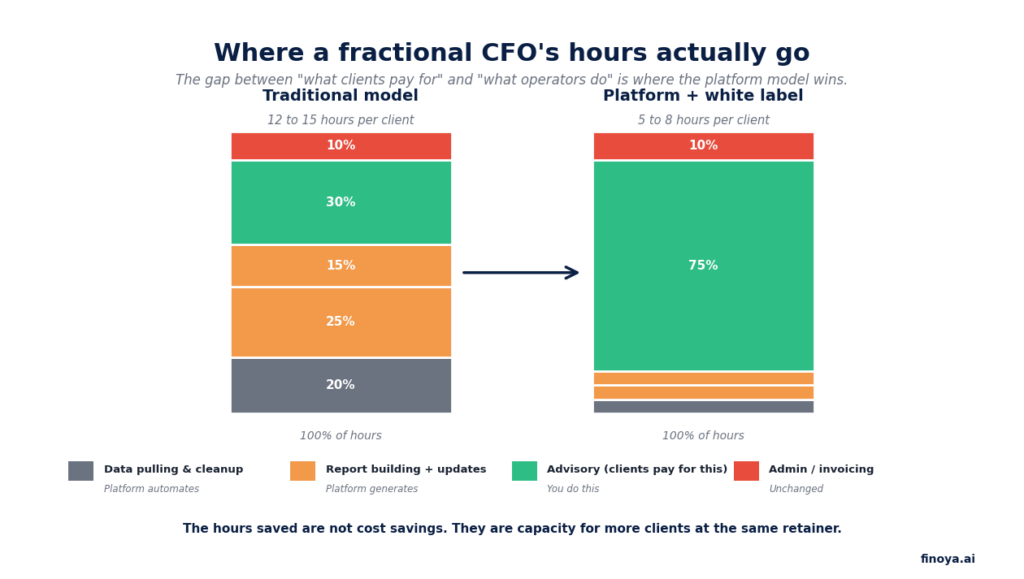
This is a margin problem disguised as a workflow problem. The operator is selling judgement at a CFO price and delivering data preparation at a CFO price. That works fine until competition shows up, or until the operator runs out of hours, or until the operator gets tired.
What changes with a platform
The shift I am seeing operators make is to use a white labelled AI platform to do the work that does not need the operator. Connect the client’s books once. The platform handles the data pulling, the monthly cash flow health check, the 90 day forecast, the variance analysis, the board pack draft. The operator spends their hours on the conversation, not the slide deck.
The retainer does not change. The hours per client drop from 12-15 to 5-8. The hours saved are not cost savings. They are capacity for more clients at the same retainer.
The annual income picture
If you do the math on what this means for one operator over a year, the answer is uncomfortable to look at if you are still running the traditional model.
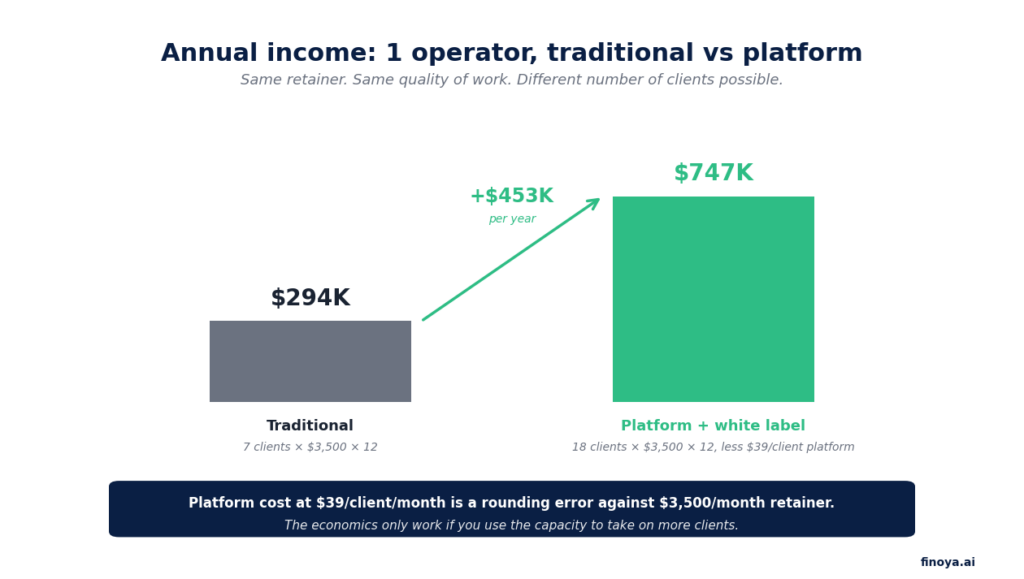
The number that surprises operators when they see it for the first time is not the revenue side, it is the platform cost. $39 per client per month against a $3,500 monthly retainer is a rounding error. The economics are not about the platform being cheap. The economics are about the platform freeing the operator’s hours so the operator can take on three times more clients at the same quality of work.
I want to be clear about the assumption that makes this work. The assumption is that the operator uses the freed hours to take on more clients. If the operator just takes the freed hours back as personal time, the platform is a cost with no return. The model only works if the capacity gets used.
Why white label matters
The other question operators ask me is why this needs to be white labelled. Why not just have the client log in to whatever AI tool the operator is using?
The answer is positioning. A fractional CFO who tells their client “go log in to Finoya” has just told the client that the value is in the tool, not in the CFO. The next logical question from the client is “why am I paying you the retainer if I am doing the work in Finoya myself?” That conversation ends one way.
The operator who white labels under their own brand has a different conversation. The client logs in to a portal that says the operator’s name on it. The reports come from the operator’s domain, with the operator’s logo, signed by the operator. The AI is invisible. The client experiences the operator as a CFO who is somehow producing better, faster, more thorough work than the last person they had. The retainer is justified by the experience, not by the hours.
This is not a marketing trick. The work is genuinely better. The operator has more time to spend on the actual judgement. The client gets more attention from the operator and faster turnaround on requests. The reports are more current because the platform updates them in real time rather than monthly. The white label part is what protects the operator’s positioning while all of that improvement happens.
What to do if you are running this model
Two things, both take less than an hour.
One, do the math on your own practice. How many clients do you have. How many hours per client per month do you actually spend on data, reports, and model maintenance, versus advisory time. If the data and report time is over 50% of your hours, you are leaving capacity on the table. The exact platform you choose matters less than recognising the gap.
Two, if you want to see what white labelling looks like under your own brand specifically, book 20 minutes with us. I will walk you through what your first month would look like, what the margins are for a practice your size, and what onboarding three to five existing clients actually involves. If it is not a fit I will tell you and point you somewhere else.
The fractional CFO operators who come out of 2026 well will not be the ones who work harder on the model maintenance. They will be the ones who stopped charging CFO rates for data preparation work, started charging CFO rates only for judgement, and used the platform to make sure their hours were spent on the part the client is actually paying for.