
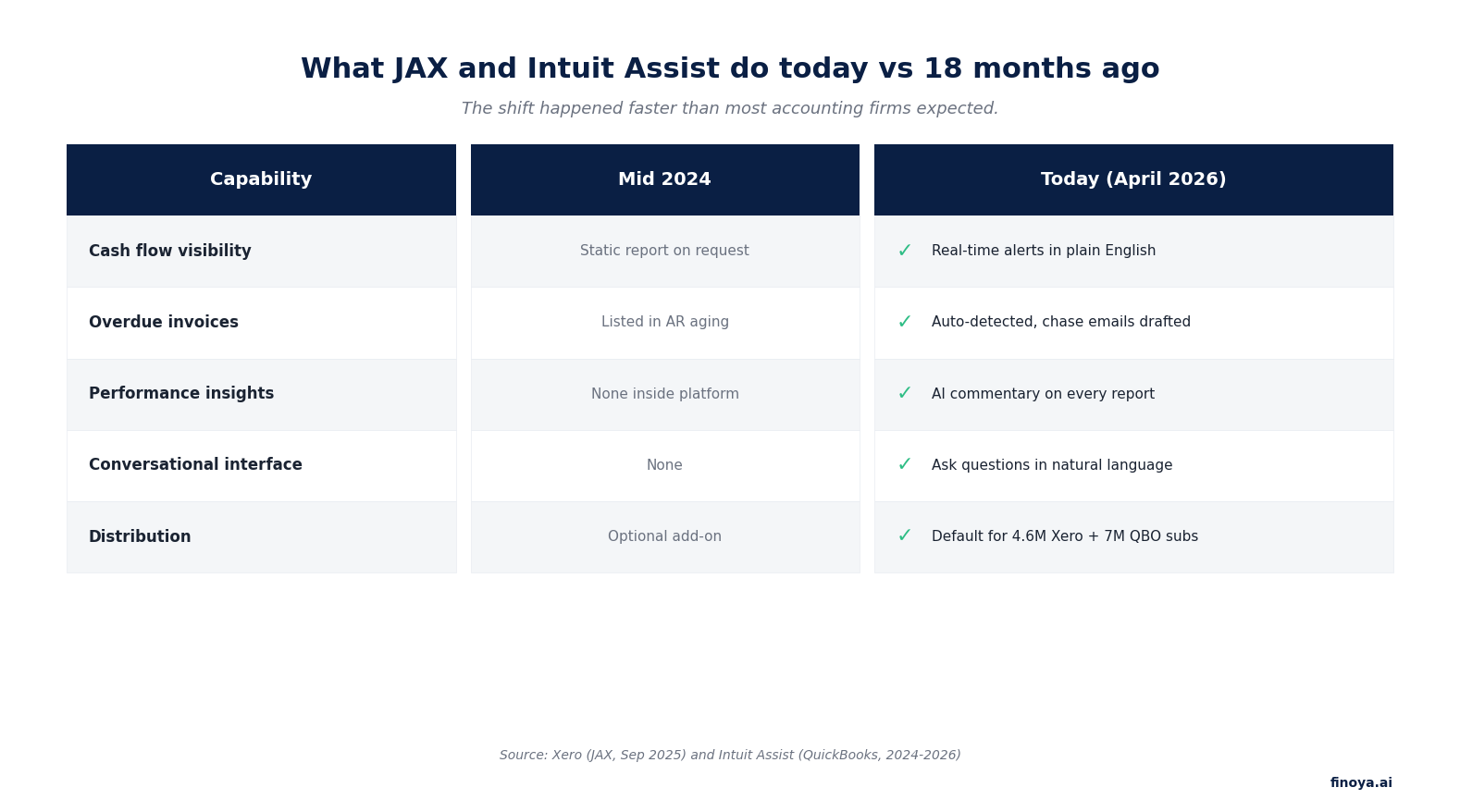
In September 2025, Xero launched JAX. Just Ask Xero. An AI agent that sits inside the Xero subscription a small business owner already pays for and answers questions about their cash flow, profit and loss, overdue invoices, and what to do next. Four months later, in January 2026, Xero rolled out enterprise grade analytics across its entire base of 4.6 million subscribers. Intuit has been doing the same thing inside QuickBooks since late 2024 with Intuit Assist, and they have only got more aggressive in 2025.
I want to put down what most accountants I speak to are not yet saying out loud.
The financial questions your clients used to call your firm about are now being answered inside the platform they were already paying for. Not by you. Not by your firm. By the software.
This is not a future problem. JAX is live. Intuit Assist is live. Both are talking to your clients right now, every time those clients log in to their own books.
If you run an accounting firm, this matters more than any other technology shift in the last twenty years. More than the move to cloud. More than the death of paper receipts. Because cloud and paperless changed how you delivered work. This changes whether your clients still need to ask you in the first place.
What is actually happening
The pitch from Xero and Intuit is the same. AI for the small business owner. Embedded. Always on. Plain English. Free with the subscription, or near enough to free that nobody will quibble.
Xero’s JAX gives clients instant access to cash flow, profit and loss, and balance sheet data. It surfaces unpaid invoices. It flags problems. It explains what the numbers mean in language a non finance person understands. Their integration with Anthropic’s Claude takes it further. A business owner can sit inside Claude, connect their Xero account, and ask any question about their finances in conversation. No accountant required.
Intuit Assist does the same on the QuickBooks side. It generates a Business Feed for the owner showing what the AI has done and what it noticed. It spots cash flow shortages in real time and suggests actions. Intuit’s own data, published December 2025, says 74% of customers using their AI agree it gives them a better picture of their financial health. Six hours saved per month per customer.
Read that again. Six hours a month. That is the time your clients used to spend either inside their books trying to figure out what was going on or on the phone to you trying to make sense of it.
Both Xero and Intuit have made it clear in their public commentary that the firm of the future is one where the accountant focuses on advisory and lets the software handle the day to day. That sounds reasonable. It sounds collaborative. But there is a quieter consequence that nobody at Xerocon or QuickBooks Connect is putting on the keynote slide.
If the software is the one delivering the insights, the client’s relationship is increasingly with the software. Not with you.
The advisory revenue problem
Here is what concerns me, and why I think most firms are underestimating this.
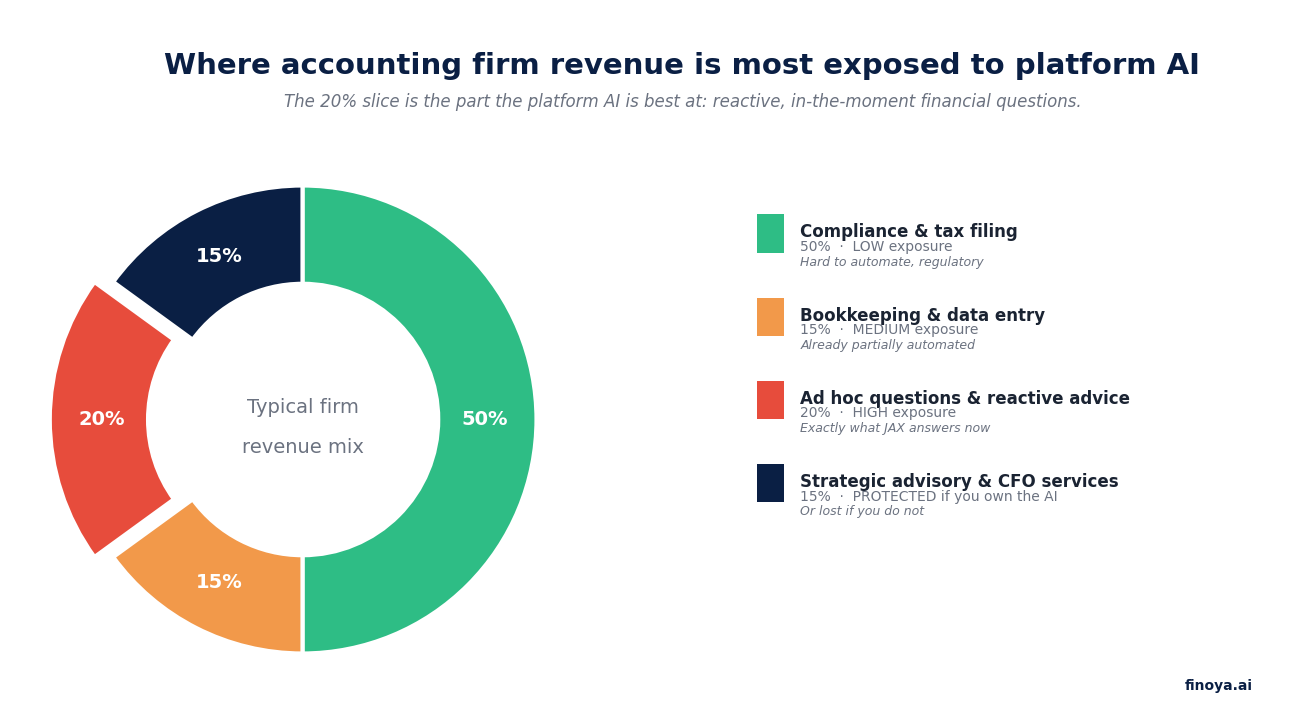
For the last decade, the smart firms have been moving away from compliance work and toward advisory. The numbers were always quoted as something like 80% of firm revenue from compliance, 20% from advisory, with the goal to flip those numbers. CPA.com has been writing about CAS 2.0 for years. Every conference has a track on it.
The plan was always the same. The accountant becomes the trusted strategic advisor, the one who explains what the numbers mean, the one who answers the question “what should I do about this.” That advisory work is where the high margins live and where the deepest client relationships get built.
That plan assumed the accountant was the only one who could give those answers in language the client could understand.
That assumption is no longer safe.
When a client logs in to QuickBooks tomorrow morning and Intuit Assist has already noticed their cash position is tight, already suggested they chase three specific overdue invoices, and already drafted the chase emails, what exactly is the client paying you the advisory retainer for? Not for noticing. The software noticed. Not for the recommendation. The software made it. Not for the action. The software took it.
You can argue that the software’s recommendation is shallow, or generic, or cannot account for the context only you know. That argument is correct today. It will be less correct in twelve months. The investment going into JAX, into Intuit Assist, into Sage’s AI work, is enormous and accelerating. These products will get better. Probably faster than most accountants expect.
So the question for every firm reading this is not “will my clients keep needing me.” The question is “what specifically will they keep needing me for, and how do I make sure that thing has my name on it, not Xero’s.”
Three responses that do not work
Before I get to what does work, let me name three responses that do not.
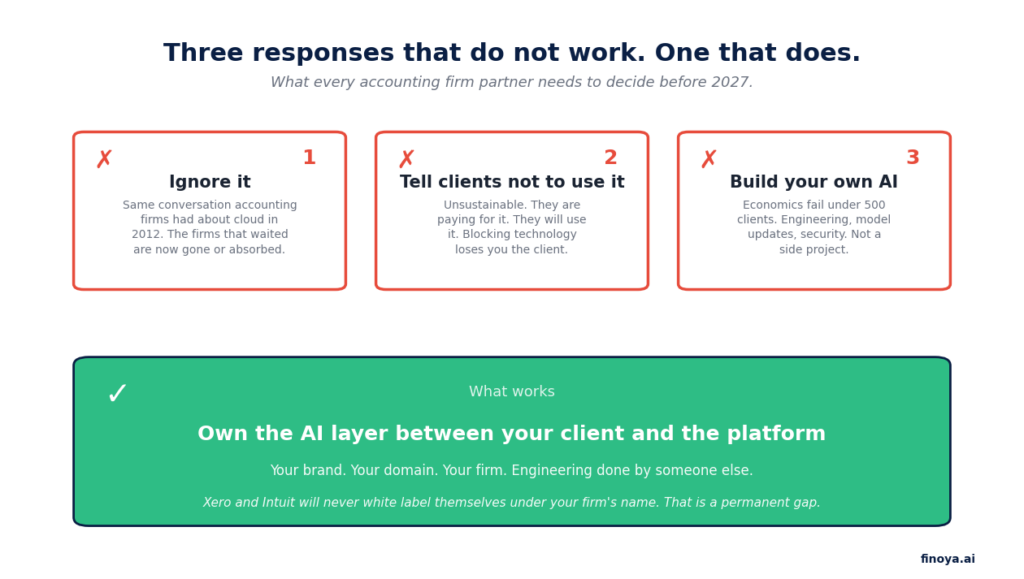
Response one: ignore it. Some firms are deciding the AI is overhyped, that small business clients are conservative, that nothing will really change. This is the same conversation accounting firms had about cloud accounting in 2012. The firms that ignored it then are now either gone or merged into firms that did not. The technology changed the floor, not the ceiling.
Response two: tell clients not to use it. A small number of firms are quietly suggesting their clients turn off the AI features, stay on older plans, avoid the chatbot. This is unsustainable. Your clients are paying for these features whether they use them or not. They will use them. And the firms that are seen as blocking technology rather than embracing it will lose those clients to firms that do.
Response three: build your own AI. A few of the largest firms are talking about building proprietary AI tools. The economics do not work for any firm with under five hundred clients, and they probably do not work for most firms with under five thousand. The infrastructure cost, the engineering team, the data work, the ongoing model updates, none of that is a side project. If you are running a firm of fifty people, this is not your fight to pick.
What does work
Here is the move I think wins.
The firms that come out of this strongest will be the ones who own the AI layer that sits between their client and the raw accounting platform. Not Xero’s AI. Not Intuit’s AI. The firm’s own AI, with the firm’s branding, that the client logs in to under the firm’s domain.
This is the white label model. It already exists. We built it.
When a client logs in to a Finoya powered platform, they see the firm’s logo, the firm’s colours, the firm’s domain. They get a cash flow health score, a 90 day forecast, scenario planning, and an AI assistant that answers their financial questions in plain English. They never see the word Finoya. To the client, this is the firm’s product. This is the firm’s AI.
Behind the scenes, we do the engineering. We do the integrations. We do the AI work. We do the model updates. We do the security and the compliance and the ongoing improvements. The firm does what the firm has always done best, which is run the relationship and apply the judgement that no AI will be able to apply for a long time yet.
The economics of this are favourable in a way that surprises most firms when they see them for the first time. A firm pays $39 per linked client per month. The firm charges its client whatever it decides to charge. Most of the firms we are working with have settled in the $150 to $200 range, which is well below what a fractional CFO costs, well above what a basic compliance retainer costs, and exactly the gap most SMEs have been sitting in for years without a good answer.
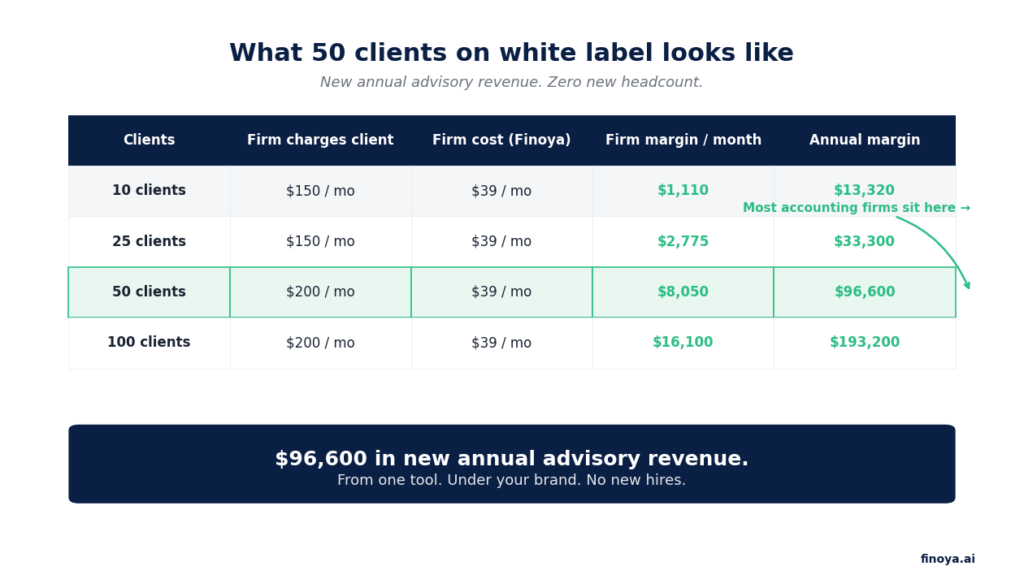
For an average firm with fifty clients on the platform, that is somewhere between $5,500 and $8,000 a month in margin, on a service that the firm did not have to build, hire for, or maintain. Annualised, that is the salary of a senior advisor or two without the salary or the search.
But the bigger point is not the revenue. The bigger point is the moat.
The moat is the brand
What Xero and Intuit cannot do is white label themselves under your firm’s name. They will never let your clients log in to “yourfirm.com” and have it be a Xero product. Their entire business model depends on Xero or QuickBooks being the brand the small business owner trusts.
That is the gap. And it is a permanent gap. Not a temporary one.
Every login your client does on the firm’s white labelled platform reinforces the firm’s brand, the firm’s relationship, the firm’s role as the place to go for financial answers. Every login your client does inside Xero or QuickBooks reinforces theirs.
The firms that come out of the next two years strongest will be the ones who decided early that the AI layer needed to be their own. Not borrowed from a platform that has every commercial reason to eventually disintermediate them.
I am not arguing this because we make a product. I am arguing this because thirty years inside Australian financial institutions taught me that the most expensive thing in financial services is being the second person the client trusts. By the time you are second, you do not get the call. You get the leftovers.
The first person your client trusts for financial answers in 2026 is the place they ask the question. If that place is your firm, you keep advisory. If that place is Xero or Intuit, you do not.
What to do this week
Three things that take less than a day in total.
1. Log in to a client’s Xero or QuickBooks account and play with their AI for thirty minutes. Ask it the questions a typical client would ask. Notice what it gets right. Notice what it misses. Notice how natural the experience feels. This is the experience your clients are now having every time they log in.
2. Count the number of clients in your firm currently paying you a monthly retainer that includes ad hoc financial questions, business performance discussions, or any kind of regular check in beyond compliance. That is the revenue most exposed to this shift. Look at it honestly.
If the number in step two is meaningful, start a conversation about how to put your firm’s brand on the AI layer before the platforms put theirs on the relationship. We made it easy to have that conversation. Book 20 minutes with me here and we will walk through what a white label setup looks like for a firm your size, including the unit economics and what your first month would look like. If we are not the right answer, I will tell you and point you somewhere else.
The firms that move on this in 2026 are the ones who will still be having advisory conversations in 2028. The firms that wait will be having a different conversation. Probably with us, probably with someone else, probably about how to compete with the firm down the road who already moved.
Either way, the question is not whether the AI is coming for the advisory call. It is already there. The question is whose name is on it when the client logs in.